Dwarf Planets: The 5 Worlds Beyond the Textbooks
There are five officially recognized dwarf planets in our solar system, and most people can only name one. That would be Pluto, obviously. But out there in the cold, dark edges of space, four other small worlds are orbiting the Sun, each with its own weird personality. One is shaped like an egg. Another caused so much drama that it got Pluto kicked out of the planet club. A third one sits between Mars and Jupiter, hiding in plain sight. These aren't just leftover space rocks. They're round, they have surfaces and sometimes atmospheres, and they're teaching us things about the solar system that the big planets can't.
What Is a Dwarf Planet?
A dwarf planet is a celestial body that orbits the Sun and has enough mass for gravity to squish it into a roughly round shape. So far, sounds like a regular planet, right? The difference comes down to one thing: a dwarf planet hasn't cleared the neighborhood around its orbit. The eight planets have all swept up or flung away most of the debris in their orbital paths. They're the gravitational bullies of their zones. Dwarf planets share their space with thousands or millions of other objects. They're round, they orbit the Sun, but they haven't dominated their neighborhoods. The International Astronomical Union created this category in 2006, and it's been controversial ever since.
How Many Dwarf Planets Are There?
Five. That's the official count from the IAU: Pluto, Eris, Ceres, Haumea, and Makemake. But here's where it gets interesting. Astronomers estimate there could be dozens, maybe hundreds, maybe even over a thousand dwarf planets in our solar system. We just haven't confirmed them yet. Objects like Sedna, Quaoar, Orcus, and Gonggong are strong candidates. The problem is that most of these potential dwarf planets are incredibly far away and incredibly dim. Confirming that something is round at 40+ astronomical units from the Sun takes serious telescope time. As technology improves, that list of five is almost certainly going to grow.
Pluto: The Most Famous Dwarf Planet
Pluto was discovered in 1930 by Clyde Tombaugh at Lowell Observatory. For 76 years, it was the ninth planet. Then in 2006, the IAU rewrote the rules and Pluto didn't make the cut. The backlash was immediate and loud. New Mexico passed a resolution declaring Pluto a planet within state borders. NASA's New Horizons mission arrived at Pluto in 2015, and what it found was stunning. A heart-shaped nitrogen glacier the size of Texas. Mountains of water ice taller than the Alps. A thin atmosphere with blue haze layers. Possible cryovolcanoes. Pluto turned out to be one of the most geologically active and visually striking places in the entire solar system. Planet or not, Pluto is doing just fine.
Eris: The Troublemaker That Dethroned Pluto
If Pluto lost its planet status, blame Eris. Discovered in 2005 by Mike Brown's team at Caltech, Eris is about the same size as Pluto but 27% more massive. That discovery forced the question: if Pluto is a planet, then Eris has to be one too. And so does anything else that size. The IAU decided to draw a line, and Pluto ended up on the wrong side of it. Eris orbits way out in the scattered disc, about three times farther from the Sun than Pluto. Its orbital period is 558 years. It has one moon called Dysnomia. The surface is covered in methane and nitrogen ice that gives it a whitish appearance. Mike Brown wrote a whole book about finding Eris. He titled it "How I Killed Pluto and Why It Had It Coming."
Ceres: The Only Dwarf Planet Between Mars and Jupiter
Ceres is the oddball of the group. While the other four dwarf planets hang out in the frozen outer solar system, Ceres sits in the asteroid belt between Mars and Jupiter. It's the largest object in the asteroid belt, about 590 miles across. Italian astronomer Giuseppe Piazzi discovered it in 1801, and people initially called it a planet. Then more asteroids kept showing up nearby, and Ceres got demoted to "asteroid" for about 200 years. When the IAU created the dwarf planet category in 2006, Ceres finally got promoted again. NASA's Dawn spacecraft orbited Ceres from 2015 to 2018 and found bright salt deposits, evidence of a subsurface ocean, and organic molecules on the surface. For such a small world, Ceres has a lot going on.
Haumea: The Egg-Shaped Dwarf Planet
Haumea is the strangest-looking dwarf planet. It spins so fast that it has stretched itself into an elongated shape, like a squashed football. A full day on Haumea lasts just under 4 hours, making it one of the fastest-rotating large objects in the solar system. It sits in the Kuiper Belt, about 43 AU from the Sun, and was officially recognized in 2008. Haumea has two small moons named Hi'iaka and Namaka. In 2017, astronomers discovered that Haumea also has a ring, making it the first known Kuiper Belt object with rings. The surface is mostly water ice, and Haumea is named after the Hawaiian goddess of fertility and childbirth.
Makemake: The Red Dwarf Planet of the Kuiper Belt
Makemake was discovered in 2005, the same year as Eris, by the same team led by Mike Brown. It's the second-brightest Kuiper Belt object after Pluto, which means amateur astronomers with big telescopes can sometimes spot it. Makemake is about 890 miles in diameter and orbits the Sun every 306 years. Its surface is covered in frozen methane, ethane, and nitrogen, which gives it a reddish-brown color. A small, dark moon nicknamed MK2 was discovered orbiting Makemake in 2016. The planet is named after the creation deity of the Rapa Nui people of Easter Island. Brown's team chose the name because they discovered it shortly after Easter.
The Kuiper Belt: Home of the Dwarf Planets
Four of the five dwarf planets live in the Kuiper Belt, a huge ring of icy objects that stretches from Neptune's orbit (about 30 AU) out to roughly 50 AU from the Sun. Think of it as the solar system's frozen storage unit. It's where leftover material from the formation of the planets ended up 4.6 billion years ago. The belt contains hundreds of thousands of objects larger than 60 miles across and trillions of smaller icy bodies. Gerard Kuiper predicted its existence in 1951, but astronomers didn't confirm it until 1992 when they spotted the first Kuiper Belt Object beyond Pluto. The Kuiper Belt is also the source of many short-period comets. When one of those icy objects gets knocked loose by gravitational nudges, it can fall inward toward the Sun and grow a tail.
When Did Pluto Become a Dwarf Planet?
August 24, 2006. That's the date the International Astronomical Union voted in Prague to redefine what counts as a planet. Only about 424 astronomers out of roughly 10,000 IAU members were in the room for the vote. The decision came down to that third rule: clearing the orbital neighborhood. Pluto shares its orbital space with thousands of other Kuiper Belt objects. It's the largest one, but it hasn't swept up the rest. Earth, by comparison, is 1.7 million times more massive than everything else in its orbit combined. The vote was tight and the debate was heated. Some scientists walked out in protest. Twenty years later, plenty of planetary scientists still argue the definition is flawed.
Dwarf Planet vs Planet: The Key Differences
Planets and dwarf planets share two of three requirements: they orbit the Sun and they're round. The dividing line is orbital dominance. A planet has cleared its orbital neighborhood of other debris. A dwarf planet hasn't. That's it. There's no size requirement in either direction. A dwarf planet could theoretically be bigger than Mercury and still be a dwarf planet if it hasn't cleared its orbit. In practice, the known dwarf planets are all much smaller than any planet. Pluto, the biggest, has about 0.2% of Earth's mass. The name "dwarf planet" is a bit misleading because, under the IAU definition, a dwarf planet is not actually a sub-type of planet. It's a separate category entirely. That naming choice annoyed a lot of people.
Could There Be Hundreds More Dwarf Planets?
Almost certainly. The outer solar system is vast and dark, and we've only scratched the surface. Astronomer Mike Brown maintains a list of potential dwarf planets based on estimated sizes. Depending on the criteria you use, there could be over 100 objects in the solar system that qualify. Some estimates go even higher, into the thousands, if you include objects in the scattered disc and the hypothetical inner Oort Cloud. The James Webb Space Telescope and future ground-based observatories will help pin down sizes and shapes of distant objects. Every few years, new candidates pop up. The solar system keeps getting more crowded and more interesting the more we look.
Why Dwarf Planets Matter for Understanding the Solar System
Dwarf planets are fossils. They're leftovers from the earliest days of the solar system, 4.6 billion years ago, when gas and dust were clumping together to form planets. The big planets grew large enough to clear their orbits. The dwarf planets didn't. Studying them tells us about the building blocks that the planets formed from. Ceres gives us clues about water and organics in the inner solar system. Pluto and the Kuiper Belt objects reveal what conditions were like in the outer solar system during formation. They're also helping scientists understand planetary migration. Neptune probably moved outward in the early solar system, scattering Kuiper Belt objects as it went. The dwarf planets are the evidence.
Planets to explore
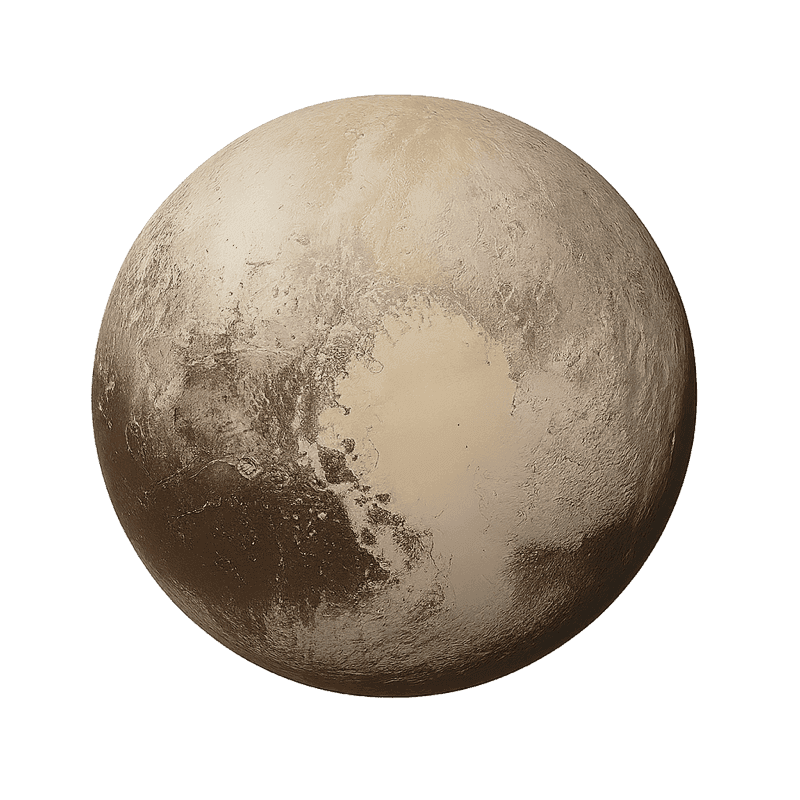
Pluto
Once the ninth planet, now a beloved dwarf planet at the edge of the Solar System.
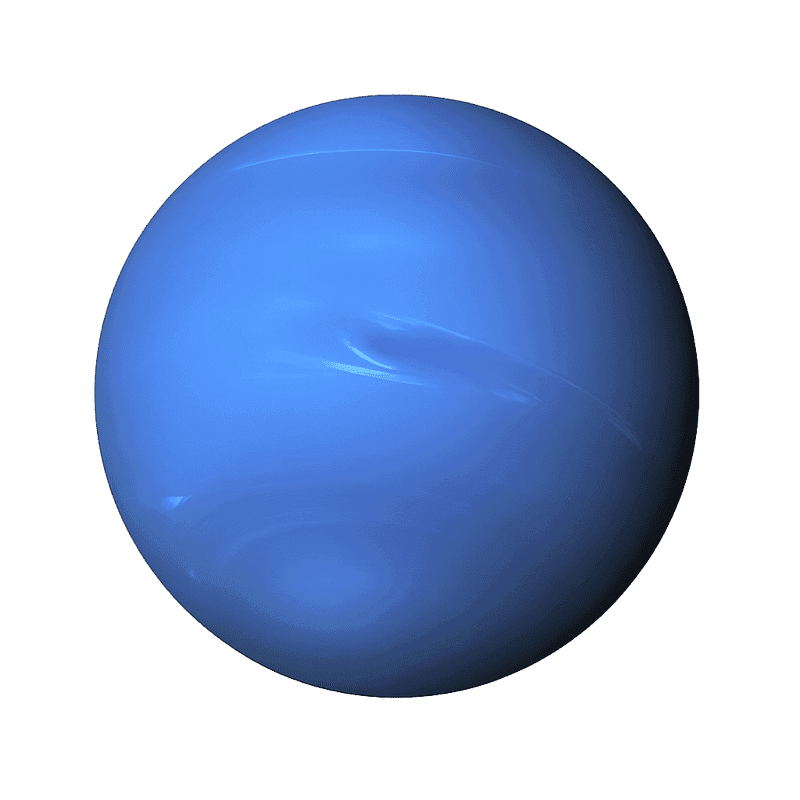
Neptune
A frigid ice giant with supersonic winds, the most distant planet in our Solar System.
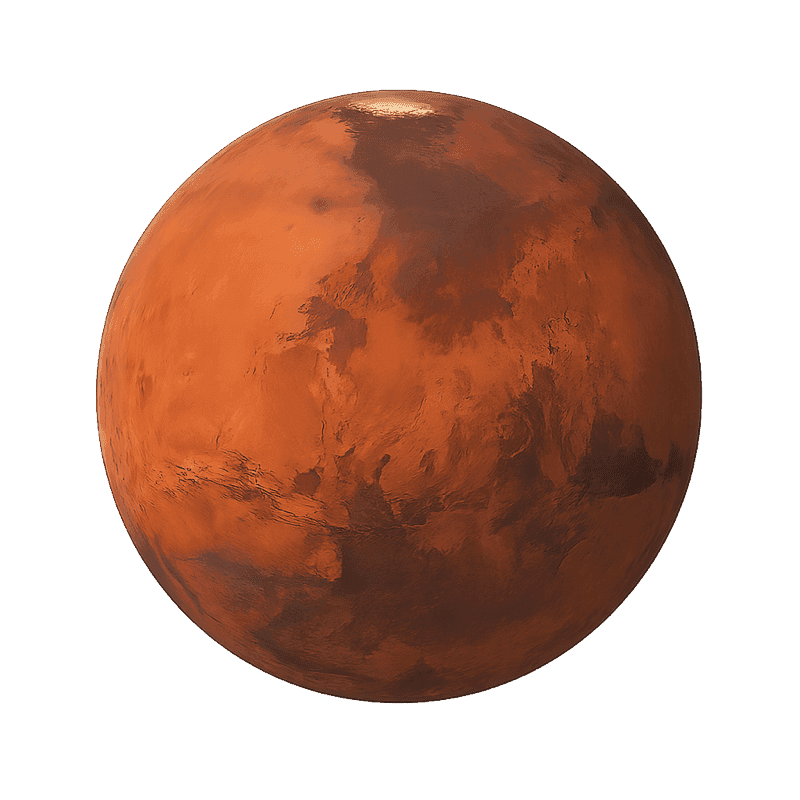
Mars
The Red Planet — a dusty, cold desert world that may have once harbored ancient rivers and lakes.
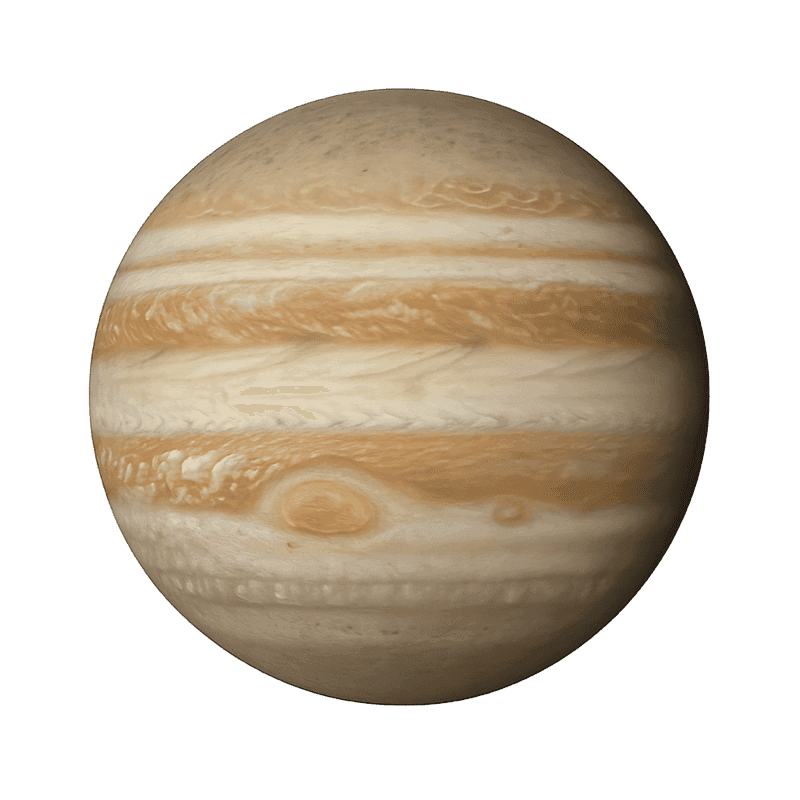
Jupiter
The king of planets — a colossal gas giant with a Great Red Spot storm raging for centuries.
Related articles & guides
Check out our planets page to explore our full catalog. You can also buy a star as a gift. Read our deep dive on is Pluto still a planet. See all 8 planets in order from the Sun. Find out how many planets there really are. Got questions? Visit our FAQ.
Frequently asked questions
Is Pluto a dwarf planet or a planet?
Pluto has been officially classified as a dwarf planet since August 24, 2006, when the IAU redefined what counts as a planet. It meets two of the three criteria (orbits the Sun, is round) but fails the third: it hasn't cleared its orbital neighborhood in the Kuiper Belt.
What is the smallest dwarf planet?
Ceres is the smallest recognized dwarf planet at about 590 miles (950 km) in diameter. It's also the only one located in the inner solar system, sitting in the asteroid belt between Mars and Jupiter.
Can you see dwarf planets with a telescope?
Pluto can be seen with a large amateur telescope (8 inches or bigger), though it looks like a faint dot. Makemake is also occasionally visible with large telescopes. Ceres can be spotted with binoculars during favorable oppositions. Eris and Haumea are too faint for most amateur equipment.
Why is Pluto no longer a planet?
Pluto was reclassified because it hasn't cleared the neighborhood around its orbit. It shares the Kuiper Belt with thousands of other icy objects. The IAU decided in 2006 that planets must be gravitationally dominant in their orbital zones, and Pluto isn't.
How many dwarf planets could there be in total?
The IAU recognizes five, but astronomers estimate there could be over 100 dwarf planets in the solar system, possibly thousands if you include objects in the scattered disc and inner Oort Cloud. Most are too far away and too dim to confirm right now.
Got Questions?
Here's everything you need to know about buying a planet
Here's the deal: this is symbolic ownership. Nobody can legally own a planet (there's actually a UN treaty about it). But what you DO get is a gorgeous personalized certificate with real astronomical data and a unique registration number. Think of it as the most original gift you can possibly give someone.
The planet's real name, your personalized owner name, a custom message if you want one, a unique registration number, and the date. It's designed to look premium enough to frame and hang on a wall.
It shows up in your email as a PDF within a few minutes of buying. You can print it at home, take it to a print shop for a nicer version, or just share it digitally. Simple.
People go crazy for it. We've sold over 3,247 planets so far and we get messages all the time from people saying it's the best gift they've ever received. It works for birthdays, Valentine's Day, Christmas, weddings, new babies... pretty much any occasion.
100%. Every planet in our catalog is a real celestial body discovered by NASA, ESA, or other space agencies. We don't make anything up. The data on your certificate comes from confirmed scientific discoveries.
No problem. You've got 30 days to change your mind. Just email us at ethan@buymyplanet.com and we'll sort it out.
Yes! We sell both planets and stars. Stars are beautiful and classic. Planets are full worlds with their own characteristics, categories, and stories. Both come with a personalized certificate and real astronomical data. Pick what fits best, or get both.
Yep! Each certificate gets its own unique registration number. It's like naming a star. The ownership is personal to you, and your certificate is one of a kind.
Right now we do instant digital PDF certificates. You can print them at home or at any print shop. We're working on framed physical versions that'll ship to your door. Stay tuned.
Totally. Symbolic planet ownership is a novelty gift, kind of like star naming services. The 1967 Outer Space Treaty says no country can claim a planet, but personalized certificates are perfectly fine. It's a beloved gift worldwide.
Name a Planet After Someone You Love
Dwarf planets remind us that the solar system is full of surprises. You can own a piece of that wonder with a personalized planet naming certificate. Real NASA data, instant digital delivery, $24.99.
Digital product. Symbolic ownership certificate.